Choosing the right commercial food mill can make high-volume sauce, soup, purée, and jam preparation faster and more consistent. The best option depends on whether you prefer manual control, electric throughput, or a balance of capacity and cleanup.
We compare 10 food mills and tomato-straining machines across construction, capacity, performance, versatility, and practical day-to-day use so you can match the equipment to your kitchen’s workload.
Best 10 Commercial Food Mill Picks for 2026
Heavy-Duty Pick
Louis Tellier N.5 Commercial Food Mill

- 8-quart stainless-steel capacity
- Processes up to 11 lb per minute
- 3 mm disc included; more available
Best For: Restaurants, caterers, and high-volume batch cooking
Versatile Manual Choice

- Three discs from 2 mm to 4 mm
- 6-quart 18/10 stainless-steel bowl
- Non-slip handles and lifetime warranty
Best For: Moderate-volume fruit and vegetable pureeing
Electric High-Volume Pick
450W Commercial Tomato Strainer

- 450W motor with 200-350 lb/h output
- Large funnel for generous loads
- One-touch operation; no assembly listed
Best For: Large tomato batches, sauces, and seed removal
Compact Traditional Option
Tellier S3 #3 Rotary Food Mill

- 5-quart manual rotary design
- Built for mashing and pureeing
- Traditional tin-plated construction
Best For: Straightforward small- to medium-batch pureeing
Best Commercial Electric Mill
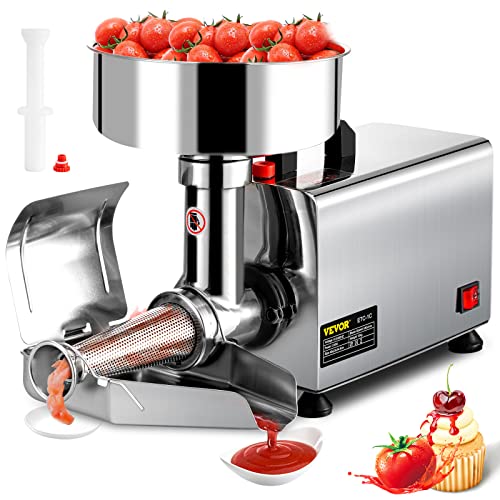
- 370W motor for high-volume processing
- 304 stainless-steel food-contact parts
- Large 9-inch funnel and adjustable trough
Best For: Bulk tomato sauces, purees, and jams
Best Manual Commercial Food Mill
Louis Tellier 5-Quart Food Mill

- Three discs for varied puree textures
- 5-quart capacity for moderate batches
- Manual, electricity-free operation
Best For: Small professional kitchens and controlled pureeing
Best High-Volume Tomato Mill

- One-pass peel and seed separation
- Large hopper for fewer refills
- Tool-free disassembly and stainless-steel components
Best For: Bulk tomato processing and harvest-season canning
Classic Manual Mill
Matfer Stainless Steel 12-1/4-inch Food Mill

- Stainless steel construction
- Three interchangeable grind grids
- Processes 2.2 to 3.3 pounds per minute
Best For: Manual batch processing with adjustable textures
High-Output Electric Strainer
COSTWAY 450W Commercial Food Mill
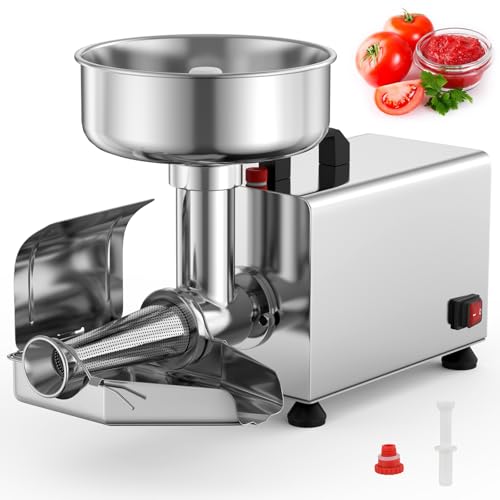
- Processes 200 to 350 pounds per hour
- 450W motor with 8.5-inch feed chute
- 304 stainless steel with tool-free disassembly
Best For: Large-batch tomato sauce and preserve production
Five-Plate Batch Mill
Winco 5-Quart Stainless Steel Food Mill

- Five interchangeable cutting plates
- Five-quart batch capacity
- Processes up to 3 pounds per minute
Best For: Manual purées, sauces, and soups with varied textures
Heavy-Duty Pick – Louis Tellier N.5 Commercial Food Mill
For restaurants, caterers, and serious batch cooking, this commercial food mill combines an 8-quart capacity with a stainless-steel construction and double milling action. It processes up to 11 pounds per minute while helping separate skins and seeds from cooked produce.
Best For: Large batches of tomatoes, potatoes, apples, vegetables, sauces, soups, compotes, and purees.
Pros:
- Processes up to 11 pounds per minute.
- Fits pots and bowls from 10-1/4 to 24 inches.
- Includes a 3 mm disc and supports four additional disc sizes.
- Durable stainless-steel construction made in France.
Cons:
- Additional discs are sold separately.
- Hand washing is recommended.
- Its large size may be more than smaller kitchens need.
The N.5 is the strongest choice here for high-volume manual processing. Its capacity, broad vessel compatibility, and fast double milling action make it well suited to commercial prep, though the footprint and optional-disc cost are worth considering.
Versatile Manual Choice – Cuisipro Deluxe Food Mill
The Cuisipro Deluxe is a practical commercial food mill for cooks who want multiple texture options in a manageable manual design. Its 6-quart stainless-steel bowl includes three interchangeable discs for adjusting puree consistency.
Best For: Pureeing fruits and vegetables for sauces, soups, and smooth side dishes.
Pros:
- Includes 2 mm, 3 mm, and 4 mm interchangeable discs.
- Extra-large 18/10 stainless-steel bowl holds 6 quarts.
- Non-slip handles provide stability during use.
- Lifetime manufacturer warranty is listed.
Cons:
- It has less capacity than the 8-quart Louis Tellier model.
- The supplied notes do not specify processing speed.
- It is a manual tool rather than an electric machine.
With three included discs and a stable stainless-steel bowl, this model offers useful flexibility without requiring separate texture accessories. It is a balanced option for moderate-volume prep where adjustable puree thickness matters.
Electric High-Volume Pick – 450W Commercial Tomato Strainer
This electric commercial food mill is designed specifically for fast tomato processing and sauce preparation. Its 450W motor, large funnel, and stated 200-350 pounds-per-hour output target users handling substantial batches of tomatoes, berries, or jam ingredients.
Best For: High-volume tomato straining, fresh sauces, seed removal, and berry jam preparation.
Pros:
- 450W motor is designed for rapid batch processing.
- Stated capacity is 200-350 pounds per hour.
- Large funnel accommodates generous loads.
- One-touch operation and no assembly are listed.
Cons:
- Its stated uses focus on straining and seed removal rather than general-purpose pureeing.
- It is less suitable if you specifically want a manual food mill.
- The supplied notes list a one-year warranty.
Choose this machine when speed and tomato-focused throughput matter more than interchangeable manual discs. The stainless-steel body and simple controls support production-oriented use, while its narrower application makes it less versatile for general mashing.
Compact Traditional Option – Tellier S3 #3 Rotary Food Mill
The Tellier S3 is a straightforward rotary commercial food mill with a 5-quart capacity and tin-plated construction. It is intended for manual mashing and pureeing when a traditional rotary design is preferred.
Best For: Small to moderate batches of mashed or pureed foods.
Pros:
- 5-quart capacity suits moderate preparation.
- Designed for mashing and pureeing.
- Traditional rotary format is simple and direct.
Cons:
- The supplied notes do not list included interchangeable discs.
- Capacity is smaller than the other manual Tellier and Cuisipro models.
- Tin-plated construction may be less corrosion-resistant than stainless steel.
This S3 is a sensible choice for cooks who want a basic rotary mill without the larger capacity or electric motor of the other options. Its limited listed specifications mean it is best suited to straightforward mashing and pureeing rather than highly adjustable processing.
Best Commercial Electric Mill – VBENLEM 370W Tomato Strainer
For high-volume sauce production, this commercial food mill uses a 370W motor and a large 9-inch funnel to process tomatoes and fruit with less manual effort. Its stainless-steel food-contact parts and adjustable discharge trough make it practical for frequent kitchen or harvest-season use.
Best For: Bulk tomato processing, sauces, ketchup, jams, and small commercial kitchens.
Pros:
- Processes up to 90–160 kg per hour according to the product title.
- 304 stainless-steel parts contact the food and are easy to disassemble.
- Low-noise operation, waterproof rating level II, and an adjustable trough.
- Suitable for tomato, strawberry, and blueberry sauces or jams.
Cons:
- Requires a 110V electrical outlet.
- At 22 pounds, it is less convenient to move than a manual mill.
- The supplied details list the main material as aluminum despite stainless-steel food-contact components.
This is a strong choice when throughput and reduced hand labor matter more than portability. The electric drive and generous funnel suit batch processing, while the removable parts help keep cleanup manageable.
Best Manual Commercial Food Mill – Louis Tellier 5-Quart Food Mill
This manual commercial food mill is a practical option for cooks who want control over texture without relying on electricity. The 5-quart bowl and three interchangeable discs handle cooked tomatoes, potatoes, apples, and vegetables for sauces, purees, coulis, compotes, and soups.
Best For: Home cooks, small professional kitchens, and controlled small-batch pureeing.
Pros:
- Includes 1.5 mm, 2.5 mm, and 4 mm discs for fine to coarse textures.
- Processes up to 3.3 pounds of food per minute.
- 5-quart capacity and manual operation require no electrical outlet.
- Made in France from traditional tinned steel.
Cons:
- Manual operation requires more effort than an electric commercial food mill.
- Tinned steel should be hand-washed and dried promptly to protect the coating.
- Its stated throughput is better suited to moderate batches than industrial production.
The Louis Tellier is a versatile, texture-focused mill for kitchens that value simplicity and precise results. Its three discs broaden its usefulness, but high-volume users may prefer an electric model.
Best High-Volume Tomato Mill – VEVOR 370W Sauce Maker
Designed for repeated sauce making, this commercial food mill combines a 370W motor with a large hopper and stainless-steel filter screen. It separates peels and seeds in one pass, making it useful for bulk tomato processing, canning, purees, and fruit jams.
Best For: Harvest-season processing, bulk canning, tomato sauce, and fruit or vegetable preparation.
Pros:
- Separates skins and seeds while producing sauce, puree, or juice.
- 370W motor and large hopper support high-volume processing.
- Stainless-steel hopper, filter screen, juice tray, and guard resist fruit acids and wear.
- Core components disassemble without tools for quick rinsing.
Cons:
- Tomatoes should be cut into small pieces to help reduce clogging.
- At 21.7 pounds, it is not especially portable.
- The supplied details do not specify an electrical voltage.
This VEVOR model is a sensible bulk-processing pick for users who prioritize speed and straightforward cleanup. Its one-pass separation and large hopper are particularly useful during canning or frequent sauce production.
Classic Manual Mill – Matfer Stainless Steel 12-1/4-inch Food Mill
If you need a dependable commercial food mill without a motor, the Matfer Stainless Steel Food Mill offers a straightforward, high-capacity design. Its three interchangeable grids let you choose a fine, medium, or large grind for sauces, purées, and other preparations.
Best For: Cooks and food-service users who want manual texture control and a durable stainless steel mill.
Pros:
- Stainless steel construction for durability and corrosion resistance.
- Includes fine, medium, and large interchangeable grids.
- Processes approximately 2.2 to 3.3 pounds per minute.
- Designed for easy cleaning.
Cons:
- Manual operation requires physical effort.
- It does not include the higher throughput of an electric machine.
The Matfer is a practical choice when adjustable results and simple operation matter more than automation. Its large 12-1/4-inch diameter and stainless steel build make it well suited to regular batch preparation.
High-Output Electric Strainer – COSTWAY 450W Commercial Food Mill
For large-volume processing, this commercial food mill uses a 450-watt full-copper motor and an 8.5-inch feed chute to produce smooth sauces efficiently. The stainless steel electric design is aimed at tomatoes, berries, pineapple, and other fruit used for sauces, jams, and preserves.
Best For: High-volume home preserving or commercial-style fruit and tomato processing.
Pros:
- Rated to process approximately 200 to 350 pounds per hour.
- Food-grade 304 stainless steel construction.
- Tool-free disassembly with detachable dishwasher-safe parts.
- Safety features include a motor guard, anti-slip feet, and a waterproof insulated switch.
Cons:
- At 22 pounds, it is substantially heavier than a manual food mill.
- Its 110-120V electric design requires a suitable power connection.
- Product care instructions specify hand washing, despite dishwasher-safe detachable parts.
The COSTWAY stands out when throughput is the priority. Its specialized fruit-and-tomato straining design, large feed chute, and powered operation make it better suited to substantial batches than occasional small portions.
Five-Plate Batch Mill – Winco 5-Quart Stainless Steel Food Mill
The Winco 5-Quart Stainless Steel Food Mill is a useful commercial food mill for purées, sauces, soups, and general food preparation. Five interchangeable cutting plates provide broad texture control, while the large capacity helps reduce the number of batches.
Best For: Batch preparation when you need multiple texture options and compatibility with larger containers.
Pros:
- Five interchangeable cutting plates offer precise texture control.
- Five-quart capacity handles substantial batches.
- Fits containers over 7 inches wide.
- Purées up to 3 pounds per minute.
Cons:
- Manual operation may be tiring during extended processing.
- Its 3.8-pound weight and 12.75-inch dimensions require adequate storage space.
Choose the Winco when versatility is more important than powered throughput. Its five plates provide more adjustment than many basic mills, and the 5-quart capacity is convenient for soups, sauces, and purées prepared in larger quantities.
How We Picked the Best Commercial Food Mills
We focused on the factors that matter most in professional and high-volume home kitchens: construction materials, hopper and bowl capacity, disc or grate options, expected output, operating method, and ease of cleaning. The selection includes manual rotary mills for controlled batch work and electric tomato strainers for faster processing of large quantities.
We also considered whether each design is suited to soft cooked vegetables, fruit, sauces, soups, and tomato processing. Published capacity and output figures can vary with produce type, preparation, and operator technique, so treat them as useful benchmarks rather than guaranteed results.
Quick Comparison
| Type | Best for | Main advantage | Trade-off |
|---|---|---|---|
| Manual stainless steel mill | Restaurants and prep kitchens | Durable, controllable, and versatile | Requires hand operation |
| Manual tinned-steel mill | Traditional batch purées | Large working capacity | Needs careful drying and storage |
| Electric tomato strainer | Large harvests and production runs | High throughput with less manual effort | Uses power and takes more counter space |
| Multi-grater mill | Mixed sauces, soups, and purées | Greater texture flexibility | More parts to manage |
Key Buying Factors for a Commercial Food Mill
Capacity and Throughput
Choose a bowl size that matches your normal batch rather than the largest advertised figure. Five-quart manual mills suit many restaurant prep tasks, while electric models rated around 200 pounds per hour or more are better for processing cases of tomatoes or seasonal produce.
Manual or Electric Operation
Manual mills are quieter, simpler, and easier to control for small or medium batches. Electric machines are more practical when speed and reduced hand labor matter, especially for tomato sauce production. Confirm that the motor voltage matches your facility before ordering.
Materials and Durability
Stainless steel is generally the easiest choice for frequent commercial use because it resists corrosion and handles repeated washing. Tinned steel can perform well but should be dried thoroughly to protect the finish. Check the frame, handle, shaft, and screen construction—not just the bowl material.
Discs, Screens, and Texture
Multiple discs or graters let you produce smooth sauces, rustic purées, or thicker vegetable mixtures. For tomato strainers, verify the included screen and whether replacement screens are available. A machine designed primarily for tomatoes may be less versatile than a rotary food mill.
Cleaning and Storage
Look for removable screens, accessible food-contact parts, and components that can be washed without trapping pulp. Electric models require extra attention around the motor housing. Allow metal parts to dry completely before storage.
Who Should Buy Which Commercial Food Mill?
Choose a stainless steel manual mill if you need dependable all-purpose prep equipment for sauces, soups, potatoes, and cooked vegetables. Pick a tinned-steel rotary mill when traditional design and larger manual batches are priorities. Choose an electric tomato strainer if you regularly process large harvests or commercial volumes and want to reduce repetitive cranking. A model with several graters is the better fit when texture flexibility matters more than maximum throughput.