Choosing the best commercial meat grinder for bones means balancing bone capacity, motor strength, throughput, durability, and cleaning requirements. The right machine can process suitable soft bones efficiently without overloading its drive system.
This roundup compares 10 heavy-duty models across different capacities and configurations, helping you match a grinder to pet food preparation, animal feed, butcher-shop work, or small-scale commercial production.
Best 10 Commercial Meat Grinder for Bones Picks for 2026
Heavy-Duty Bone Crusher
High-Capacity Poultry Bone Grinder

- Processes up to 200–230 kg per hour
- Cast-iron body with stainless steel food-contact parts
- Designed for poultry and fish bones, not beef bones
Best For: High-volume processing of poultry, fish, and similar soft bones
Versatile Commercial Mincer

- Handles up to 552 lb of meat per hour
- Includes plates, stuffing tubes, and kibbe kit
- Explicitly not suitable for bones or frozen meat
Best For: Commercial meat, sausage, and kibbe preparation without bones
Pet-Food Bone Grinder
Huanyu 1.3 HP Heavy-Duty Model

- Designed for poultry, rib, and small-game bones
- Offers touchscreen speed and reverse controls
- Includes three plates plus sausage and Kubbe kits
Best For: Raw pet-food preparation and moderate bone grinding
Soft-Bone Grinding Package
- Handles specified chicken, rabbit, squirrel, and quail bones
- Claims 220–260 lb per hour for meat
- Includes six plates and extensive sausage-making accessories
Best For: Home or small-scale users needing soft-bone and meat versatility
High-Output Bone-Capable Grinder
Newhai 1.3HP Commercial Meat Grinder

- 950W copper motor with claimed output up to 370 lb/h
- Handles soft chicken and fish bones
- Includes three plates, two blades, and sausage tube
Best For: Small restaurants needing high-throughput soft-bone grinding
Farm-Processing Workhorse
ARINOO #12C Commercial Meat Grinder

- 1.0HP copper motor with 1100W peak power
- Large hopper for bulk meat processing
- Five-year warranty and sausage-making accessories
Best For: Home butchers, hunters, and small farms processing large meat batches
Compact Bone-Mincer Setup
Anatole 1.3HP Commercial Bone Mincer

- 950W pure-copper motor with cooling system
- Four plates, two blades, and four sausage stuffers
- Compact design with removable auger and outlet
Best For: Smaller kitchens needing versatile grinding and sausage-making accessories
Top High-Capacity Pick

- Processes chicken cartilage and bones, plus fresh and frozen meat
- 1.5 HP motor rated for up to 21 lb per minute
- Includes multiple plates, blades, and sausage tubes
Best For: High-volume poultry, sausage, restaurant, and pet food preparation
Best Heavy-Duty Value
- 1100W copper motor with 225 RPM blade speed
- Rated for up to 330 lb of meat per hour
- Includes two blades, two plates, and a sausage tube
Best For: High-throughput meat and vegetable mincing
Best Commercial Throughput
Tangkula #12 551-Lb/Hour Grinder

- Listed capacity reaches up to 551 lb per hour
- 1100W motor with a steel gear-driven mechanism
- Includes two plates and two blades for varied grinds
Best For: High-volume commercial meat grinding and sausage preparation
Heavy-Duty Bone Crusher – High-Capacity Poultry Bone Grinder
If you need a commercial meat grinder for bones, this 2,200W machine is designed for high-volume processing of poultry, fish, lamb, pork, and similar ingredients. Its stated output is 200–230 kg per hour, though the manufacturer specifically cautions against using it for beef or other very hard bones.
Best For: Commercial kitchens, feed preparation, and users processing chicken, duck, fish, and other relatively soft bones in large batches.
Pros:
- High stated capacity of 200–230 kg per hour.
- Thick-coated cast-iron body with stainless steel hopper and safety cover.
- Four casters, discharge tray, and emergency-stop switch support practical operation.
- Screw design is intended to produce a fine texture while reducing manual effort.
Cons:
- Not suitable for beef bones or other very hard bones.
- Ingredients must be cut into small pieces before grinding.
- Do not allow the machine to run empty for too long, as this may damage the blades.
This is the strongest capacity-focused option in the group, but its bone range is limited. Confirm that your ingredients match the manufacturer’s poultry- and fish-bone guidance before buying.
Versatile Commercial Mincer – VEVOR #12 Meat Grinder
Although this VEVOR model is a capable commercial meat grinder, it is not a commercial meat grinder for bones. The 750W motor handles meat, fish, vegetables, and peppers at up to 552 lb per hour, but the supplied guidance says it is not suitable for bones or frozen meat.
Best For: Restaurants, butcher shops, and sausage-making setups that need high-volume meat grinding without bone processing.
Pros:
- Processes up to 552 lb of meat per hour with a 750W/1 HP motor.
- Includes two grinding plates, two blades, three stuffing tubes, and a kibbe kit.
- Removable parts are dishwasher-safe for easier cleanup.
- ETL approval, cooling, and anti-vibration feet support stable operation.
Cons:
- Not suitable for bones or frozen meat.
- The motor housing should only be wiped rather than immersed or rinsed.
- It is better suited to meat preparation than bone grinding.
Choose this model for meat, sausage, and kibbe production—not for bone grinding. Its accessory package and cleaning design make it a practical commercial mincer when bone capability is not required.
Pet-Food Bone Grinder – Huanyu 1.3 HP Heavy-Duty Model
For shoppers seeking a commercial meat grinder for bones, the Huanyu stands out because it is specifically marketed for pet-food preparation and most bones, including poultry, ribs, and small game. Its 1.3 HP motor, adjustable speed control, and stainless steel components are aimed at demanding grinding tasks.
Best For: Hunters and pet owners preparing raw pet food from meat and most poultry, rib, and small-game bones.
Pros:
- Designed to grind most bones, including poultry, ribs, and small game.
- 1.3 HP pure-copper motor can run continuously for up to 60 minutes without overheating, according to the supplied notes.
- Touchscreen offers variable speed adjustments and reverse control.
- Includes 3mm, 5mm, and 7mm plates, plus sausage and Kubbe attachments.
Cons:
- Its stated throughput is 4.4 lb of meat per minute, lower than the largest machine in this roundup.
- Capacity is listed at 6.6 lb, so larger batches may require more frequent loading.
- It is a compact model, which may be less suitable for the highest-volume commercial production.
This is the most purpose-built choice for bone-inclusive pet-food work. The adjustable controls and multiple plates add flexibility, while the compact design may suit space-limited kitchens better than oversized commercial units.
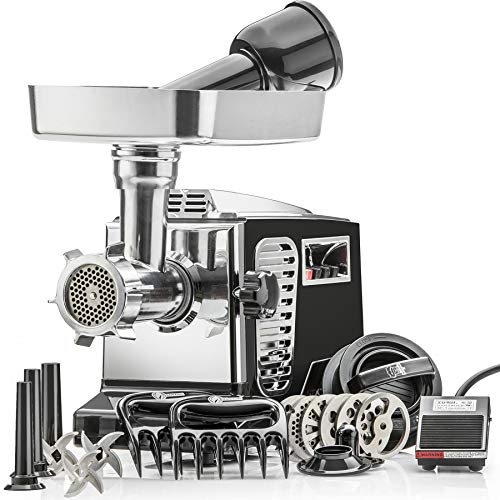
Soft-Bone Grinding Package – STX Turboforce II 4000
The STX Turboforce II is a versatile high-powered grinder for meat and soft bones rather than a machine for hard-bone processing. Its notes identify chicken, rabbit, squirrel, and quail bones as suitable, with a claimed meat capacity of roughly 220–260 lb per hour depending on the plate and meat type.
Best For: Home users, hunters, and small-scale food preparation who want soft-bone capability alongside extensive sausage and burger-making accessories.
Pros:
- Handles specified soft bones such as chicken, rabbit, squirrel, and quail bones.
- Size No. 12 design and claimed 220–260 lb-per-hour meat throughput support substantial batches.
- Includes six grinding plates, stainless steel blades, sausage tubes, and a Kubbe maker.
- Foot pedal, air-cooling system, and circuit breaker add operating convenience and protection.
Cons:
- Suitable only for soft bones listed by the manufacturer, not hard bones generally.
- The extensive accessory package may be more than needed for simple grinding.
- The stated three-year guarantee has geographic and terms-related limitations.
This package is a strong fit when soft-bone grinding is only one part of the job. Its accessory selection is unusually broad, but buyers should stay within the manufacturer’s specific soft-bone guidance.
High-Output Bone-Capable Grinder – Newhai 1.3HP Commercial Meat Grinder
If you need a commercial meat grinder for bones, the Newhai combines a 950W copper motor with a stainless-steel body and multiple plate sizes. It is specified for soft chicken and fish bones, along with meat, vegetables, and sausage preparation.
Best For: Small restaurants and countertop users who need high-throughput grinding and occasional soft-bone processing.
Pros:
- 950W, 1.3HP motor with claimed efficiency up to 370 lb/h.
- Designed to handle soft chicken and fish bones, plus meat and vegetables.
- Includes 3mm, 6mm, and 8mm plates, two blades, and a sausage-stuffer tube.
- 304 stainless-steel construction is durable, rust-resistant, and easy to clean.
Cons:
- Its approximately 40–46 lb weight may be substantial for frequent repositioning.
- It is intended for soft bones rather than general-purpose hard-bone grinding.
With its high stated output and complete plate selection, this Newhai is a practical fit for small commercial kitchens. Confirm that your intended bone types fall within its soft-bone capability before buying.
Farm-Processing Workhorse – ARINOO #12C Commercial Meat Grinder
For shoppers comparing a commercial meat grinder for bones and bulk processing, the ARINOO #12C emphasizes torque, a large hopper, and durable stainless-steel construction. Its supplied specifications focus on meat, game, sausage making, and pet-food preparation rather than explicitly rating it for bone grinding.
Best For: Home butchers, hunters, and small farms processing large batches of beef, pork, lamb, venison, or scraps.
Pros:
- 1.0HP pure-copper motor with 650W normal rating and 1100W peak power.
- Oversized hopper supports larger batches of prepared meat.
- Includes 6mm and 8mm plates, two stainless-steel knives, a stomper, and three stuffing tubes.
- Detachable parts can be washed with water, and the product includes a five-year warranty.
Cons:
- The supplied notes do not specifically confirm soft- or hard-bone grinding.
- At about 43 lb, it is not especially lightweight.
- Only 6mm and 8mm plates are listed, limiting grind-size options.
This is a strong batch-processing option for meat and game, but buyers specifically seeking bone grinding should verify the manufacturer’s approved bone types before use.
Compact Bone-Mincer Setup – Anatole 1.3HP Commercial Bone Mincer
The Anatole is a compact commercial meat grinder for bones and general food preparation, with a 950W pure-copper motor and stainless-steel grinding components. Its supplied description identifies it as a bone mincer while also supporting meat, pet food, vegetables, and sausage making.
Best For: Home, restaurant, or hotel users who want multiple grind plates and sausage accessories in a space-saving design.
Pros:
- 950W, 1.3HP pure-copper motor with an advanced cooling system.
- Includes four grinding plates, two cross blades, and four sausage-stuffer sizes.
- Stainless-steel body, tray, plates, and blades are dishwasher safe.
- Removable outlet and auger make clearing blockages easier.
Cons:
- Aluminum-alloy parts require hand washing rather than dishwasher cleaning.
- The listed capacity is 2.5 kg, so it may suit smaller batches better than heavy production.
- The product details contain conflicting voltage information, so buyers should confirm compatibility before ordering.
Its compact footprint and broad accessory set make the Anatole versatile for smaller workspaces. The removable grinding path is useful for maintenance, while the voltage discrepancy warrants verification before purchase.
Top High-Capacity Pick – VEVOR #32 21-Lb/Min Grinder
For buyers seeking a commercial meat grinder for bones, this VEVOR model stands out for its stated ability to process chicken cartilage and chicken bones alongside fresh, frozen, and other meats. Its 1.5 HP motor, stainless steel build, and included sausage-making accessories make it suitable for demanding home or commercial prep.
Best For: High-volume grinding, bone-inclusive poultry processing, sausage making, restaurants, butcher shops, and pet food preparation.
Pros:
- Processes up to 21 pounds of meat per minute with a 1100W/1.5HP motor.
- Supplied with two blades, multiple grinding plates, and three sausage tubes.
- Reverse function, overload reset, cooling system, and ETL listing support practical operation.
- Dishwasher-safe removable grinding components simplify cleanup.
Cons:
- At 73 pounds, it is substantially heavier than the other listed options.
- The main body must be wiped rather than immersed or rinsed.
- Its large #32 footprint may be more machine than a small kitchen needs.
This is the most feature-rich choice in the group for users who specifically need stated chicken-bone and cartilage capability. The cooling and jam-clearing features are useful for extended workloads, while the broad accessory package adds flexibility beyond basic grinding.
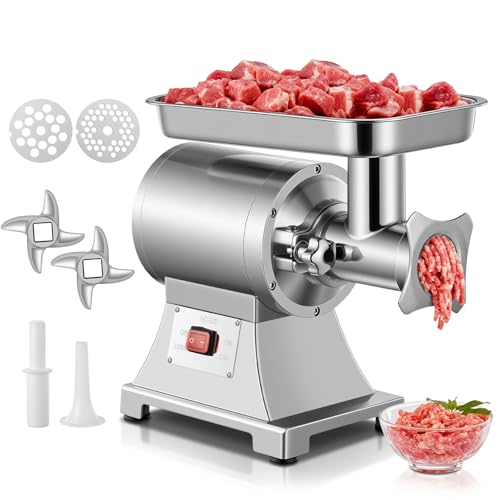
Best Heavy-Duty Value – 1100W 330-Lb/Hour Grinder
This commercial meat grinder for bones is a compact heavy-duty option for buyers prioritizing motor power and straightforward operation. The 1100W copper motor is rated for up to 330 pounds per hour, while the stainless steel food-contact components support routine kitchen, restaurant, and butcher-shop use.
Best For: Continuous meat mincing, sausage preparation, restaurant kitchens, butcher shops, and buyers who want a simpler commercial setup.
Pros:
- 1100W motor and 225 RPM blade speed are designed for heavy-duty use.
- Includes two cutting blades, two cutting plates, and a sausage tube.
- Food-contact parts such as the hopper, grinding head, and feed screw use stainless steel.
- Rated capacity reaches up to 330 pounds of meat per hour.
Cons:
- The supplied notes list meat and vegetable processing but do not specifically confirm bone grinding.
- The aluminum body may offer less stainless-steel coverage than the VEVOR model.
- Only one sausage tube is included.
This model makes sense when throughput and uncomplicated maintenance matter more than an extensive accessory set. Because bone processing is not specifically confirmed in the supplied details, buyers should verify that use before choosing it for a bone-focused workflow.
Best Commercial Throughput – Tangkula #12 551-Lb/Hour Grinder
For commercial buyers comparing a meat grinder for bones, the Tangkula offers the highest listed throughput of the three products at up to 551 pounds per hour. Its 1100W motor, 225 RPM cutting speed, steel gear-driven mechanism, and #12 grinding setup are aimed at sustained meat grinding rather than specifically documented bone processing.
Best For: High-volume commercial meat grinding, meatloaf and sausage preparation, restaurants, and company kitchens.
Pros:
- Listed capacity of up to 551 pounds per hour exceeds the other options.
- 1100W motor and steel gear-driven mechanism support powerful operation.
- Includes two 6 mm and 8 mm grinding plates plus two blades.
- Ventilation, a food pusher, and a simple on/off control support practical use.
Cons:
- The notes do not specifically state that it can grind bones.
- The included plate selection is narrower than the VEVOR package.
- Its 49-pound weight and 18-by-8-by-15-inch size still require dedicated counter or work space.
This is the throughput-oriented choice for users processing large quantities of meat. It can be attractive for commercial kitchens that need a fast, relatively compact grinder, but shoppers requiring confirmed bone grinding should seek clarification before purchase.
How We Picked the Best Commercial Meat Grinder for Bones
We focused on machines marketed for commercial or heavy-duty use, giving priority to motor power, stated processing capacity, grinder-head size, construction, included plates, and suitability for soft-bone applications. We also considered practical features such as sausage attachments, foot-pedal operation, stainless-steel components, removable parts, and the availability of multiple grinding sizes.
Capacity claims can vary with the meat temperature, bone size, feed rate, plate opening, and operator technique. Treat published pounds-per-hour figures as best-case guidance rather than a guaranteed continuous output.
Quick Comparison
| Best For | What to Look For |
|---|---|
| Pet food and soft bones | Explicit bone-grinding support, strong reduction gearing, and appropriate feed openings |
| Butcher shops and high volume | #22 or #32 heads, 1.5 HP-class motors, and high stated throughput |
| Small commercial kitchens | #12 machines with manageable footprints and multiple plate sizes |
| Sausage production | Included stuffing tubes, steady feed performance, and easy plate changes |
| Occasional heavy-duty use | Durable stainless construction, overload protection, and accessible replacement parts |
Key Buying Factors for a Commercial Meat Grinder for Bones
Bone Compatibility
Not every meat grinder can safely process bones. Confirm that the manufacturer specifically supports soft bones and follow its size and preparation limits. Poultry, rabbit, and other relatively small bones are generally more appropriate than large, dense leg bones. Never assume a powerful motor makes an unsuitable grinder safe for hard bones.
Motor, Gearbox, and Throughput
Horsepower matters, but gearbox design and sustained-duty ratings matter just as much. A grinder advertised at 1.3 or 1.5 HP may perform differently depending on transmission quality and cooling. Choose a larger #22 or #32 head when you need higher volume, while a #12 model may be more practical for smaller batches.
Plates, Knives, and Feed Design
Multiple plate sizes improve flexibility for coarse chopping, fine grinding, and sausage preparation. Check whether replacement knives and plates are easy to source. A wide tray and feed throat can reduce prep time, but ingredients should still be cut to the manufacturer’s recommended size.
Cleaning and Safety
Look for removable grinding components, corrosion-resistant metal, stable feet, overload protection, and a clearly accessible power switch. Clean and sanitize food-contact parts promptly, and verify whether components are dishwasher-safe before using a dishwasher.
Who Should Buy Which Commercial Meat Grinder for Bones?
Choose a dedicated bone-capable machine when pet food or animal-feed production is the main goal. Select a high-capacity #32 model for frequent commercial batches, while a #12 grinder is better suited to smaller shops, food stalls, or mixed household-and-business use. Buyers focused on sausage making should prioritize included stuffing tubes and easy plate changes. If portability and cleanup matter most, favor a simpler stainless model with removable parts over the highest-capacity design.